Rooted in Tradition. Guided by Compassion. Open to Science.
Dr. Indunil is an Ayurvedic physician, naturopathic practitioner, homeopath, researcher, and psychological counsellor whose work brings together traditional systems of medicine and contemporary perspectives on health.
Born in Sri Lanka, she has studied and practised across several continents, gaining experience in diverse medical traditions and cultural approaches to health and healing. Her interdisciplinary background encompasses classical Ayurveda, traditional Sri Lankan medicine, naturopathy, complementary medicine, classical homeopathy, herbal medicine, psychological counselling, dark-field microscopy, and scientific research.
At the heart of her work lies a simple but enduring principle: to approach every person with compassion, curiosity, and respect.
A Life Dedicated to Medicine and Healing
Dr. Indunil was born and raised in Sri Lanka, where Buddhist philosophy and its emphasis on compassion, mindfulness, and respect for all forms of life formed an integral part of the culture in which she grew up.
From an early age, these values shaped her understanding of health and human well-being. They ultimately inspired her to pursue a life dedicated to medicine, healing, and the alleviation of suffering.
Her academic journey began with the study of Ayurvedic medicine. She completed the comprehensive Bachelor of Ayurvedic Medicine and Surgery with honours, receiving extensive education in classical Ayurvedic theory, diagnostics, pharmacology, internal medicine, surgery, and traditional therapeutic procedures.
Her education later expanded into psychological counselling, naturopathy, complementary medicine, classical homeopathy, and scientific research. This broad academic foundation enables her to consider health from multiple perspectives while recognising the close relationships between the body, mind, environment, and individual way of life.
An Interdisciplinary Medical Perspective
Throughout her professional journey, Dr. Indunil has studied and worked across different countries, cultures, and medical traditions.
Her experience encompasses classical Ayurveda, traditional Sri Lankan medicine, Indian alchemical and herbal traditions, classical homeopathy, naturopathy, psychological counselling, dark-field microscopy, and a range of complementary therapeutic approaches. Encounters with healing traditions in Asia, Europe, and the Americas have further shaped her interdisciplinary understanding of medicine.
Rather than viewing traditional, homeopathic, naturopathic, and modern approaches as opposing systems, she is particularly interested in the dialogue between them. Her work explores how established medical traditions can be preserved, carefully examined, and applied in ways that remain understandable and practically relevant in the contemporary world.
Clinical Practice
In her clinical work, Dr. Indunil combines careful observation, traditional diagnostic principles, and an individualised therapeutic approach. Each person is considered within the wider context of constitution, symptoms, lifestyle, emotional well-being, and environment.
Her areas of practice include Ayurvedic consultation and treatment, Panchakarma therapies, Nasya, classical homeopathy, herbal medicine, dark-field microscopy, thermography, ozone therapy, and other complementary approaches to health.
Her aim is not merely to address individual symptoms, but to understand the broader patterns that may influence a person’s well-being. Compassionate communication, personal attention, and respect for each individual’s experience remain central to her therapeutic work.
Research and Academic Work
Alongside clinical practice, scientific inquiry forms an important part of Dr. Indunil’s work.
Her research has addressed Ayurvedic therapeutics, Rasāyana, traditional psychiatric treatments, medicinal plants, sleep, and Nasya. A particular focus of her academic work is the examination of traditional medical concepts in relation to contemporary anatomical, physiological, and clinical perspectives.
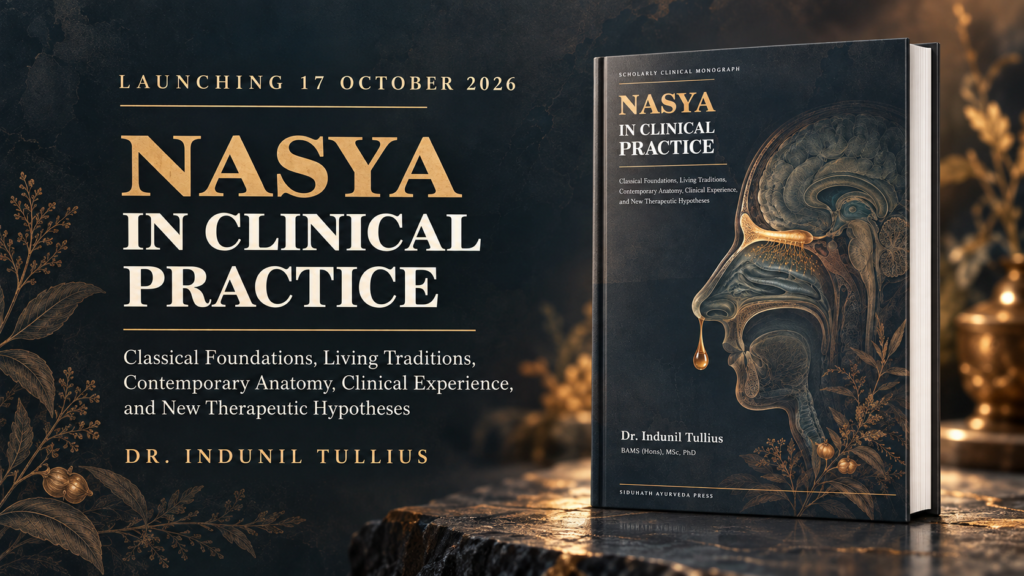
Her doctoral research, Nasya in Ayurvedic Medicine: Classical Foundations and Contemporary Clinical Applications, explores the theoretical foundations, historical development, therapeutic principles, and modern clinical relevance of Nasya—the Ayurvedic administration of medicinal substances through the nasal passages.
Through her research, publications, clinical observations, and educational work, she seeks to contribute to a deeper and more nuanced understanding of Ayurveda while preserving respect for the traditions from which this knowledge originates.
Education and Further Training
- PhD in Ayurveda
- Master of Science in Naturopathy and Complementary Medicine
- Bachelor of Ayurvedic Medicine and Surgery with Honours — BAMS (Hons.)
- Diploma in Psychological Counselling
- Homeopathy Training, Levels A–D — German Central Association of Homeopathic Physicians
- Social Science Research Methodologies
- Introduction to the Biology of Cancer — Johns Hopkins University
- Introduction to Breast Cancer — Yale University
- Bacteria and Chronic Infections — University of Copenhagen
- The Nordic Diet — University of Copenhagen
- Certified First-Aid Instructor
Selected Scientific Publications
Doctoral Dissertation
Nasya in Ayurvedic Medicine: Classical Foundations and Contemporary Clinical Applications (2026)
Master’s Thesis
Einfluss einer täglichen Kopfhautmassage mit Sesamöl auf die Schlafqualität: Eine randomisierte kontrollierte Studie(2026)
Specialist Publication
Arjuna – Eine Heilpflanze mit kardiovaskulärer Relevanz.
zkm – Zeitschrift für Komplementärmedizin, 2025, 3, 34–35. Thieme.
Further Research Publications
A Darkfield Perspective of Rasa and Rakta Dhatus with Reference to Ayurvedic Rasayana Herbs (2014)
Ayurvedische und moderne Perspektiven der Maw-Kiri-Nasya-Behandlung in der traditionellen Psychiatrie Sri Lankas(2014)
Klinische Studie zur Wirkung von Anaemi Plus Sirup bei Eisenmangelanämie (2012)
Spezifische Behandlungsmethoden in der traditionellen Psychiatrie (2012)
Philosophy
Despite the many disciplines, countries, and traditions that have influenced Dr. Indunil’s professional journey, the principle at its foundation has remained unchanged:
To meet every person with compassion, curiosity, and respect—and to contribute, wherever possible, to the alleviation of suffering and the promotion of well-being.
Sabbe sattā bhavantu sukhitattā.
May all beings be well and happy.
Dr. Indunil
BAMS (Hons.), M.Sc., PhD