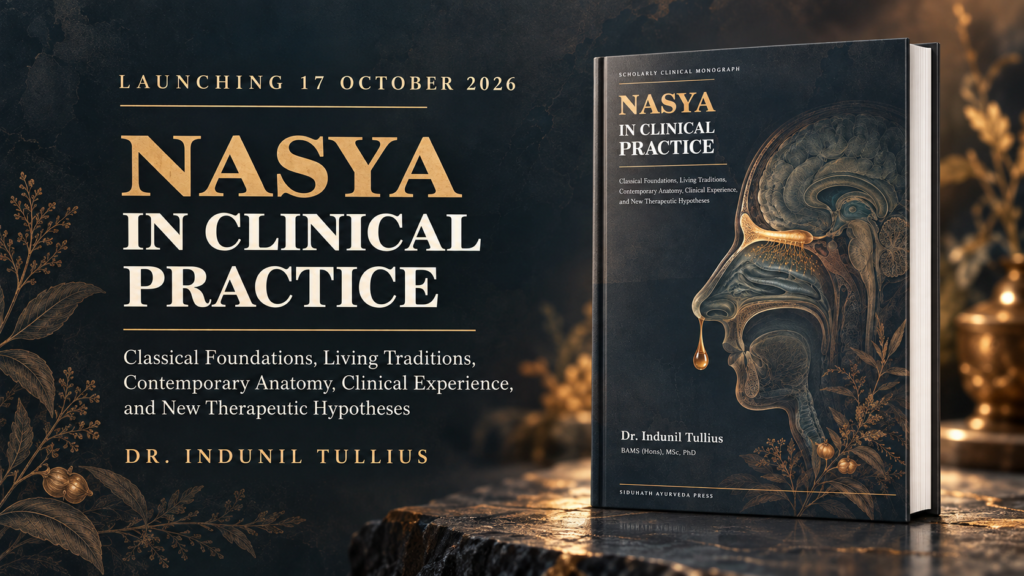
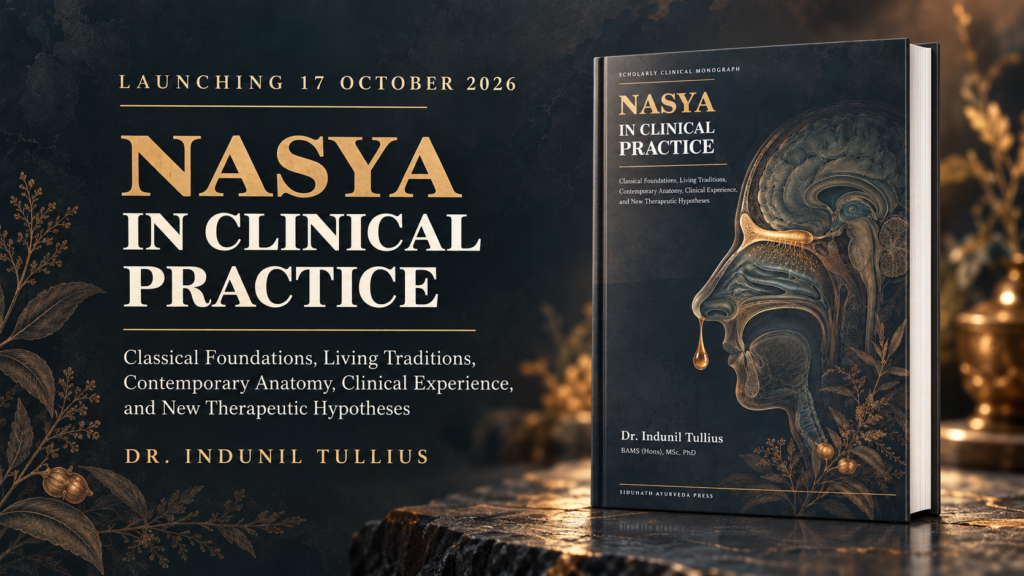
Nasya in Clinical Practice
Classical Foundations, Living Traditions, Contemporary Anatomy, Clinical Experience, and New Therapeutic Hypotheses
A scholarly exploration of Ayurvedic nasal therapy—rooted in classical texts, informed by clinical practice, and presented in conversation with contemporary anatomy and research.
Nasya is more than the administration of a medicine through the nose. In Nasya in Clinical Practice, Dr. Indunil Tullius examines it as a complete therapeutic discipline, bringing classical Ayurvedic teachings and living traditions into dialogue with clinical experience and contemporary anatomical perspectives.
Drawing on foundational Ayurvedic texts, later literature, and traditional practice, the book explores how Nasya is selected, prepared, administered, and followed by appropriate aftercare. It discusses patient suitability, the choice of formulations and dosage, and the interpretation of therapeutic responses. Detailed clinical cases illustrate its application in neurological, respiratory, sensory, and other disorders of the head region.
The monograph also presents Sri Lankan traditional psychiatric practice, Maw kiri Nasya, direct microscopic observations, and original models concerning possible connections between the nasal route and neurovascular, sensory, immune, and neuroendocrine processes. Classical teachings, clinical observations, existing research, and newly proposed hypotheses are distinguished throughout, giving readers a clear view of the different kinds of evidence and interpretation involved.
Written for Ayurvedic practitioners, healthcare professionals, researchers, and readers of integrative medicine, this book offers a clinically grounded study of Nasya and its place in contemporary practice.
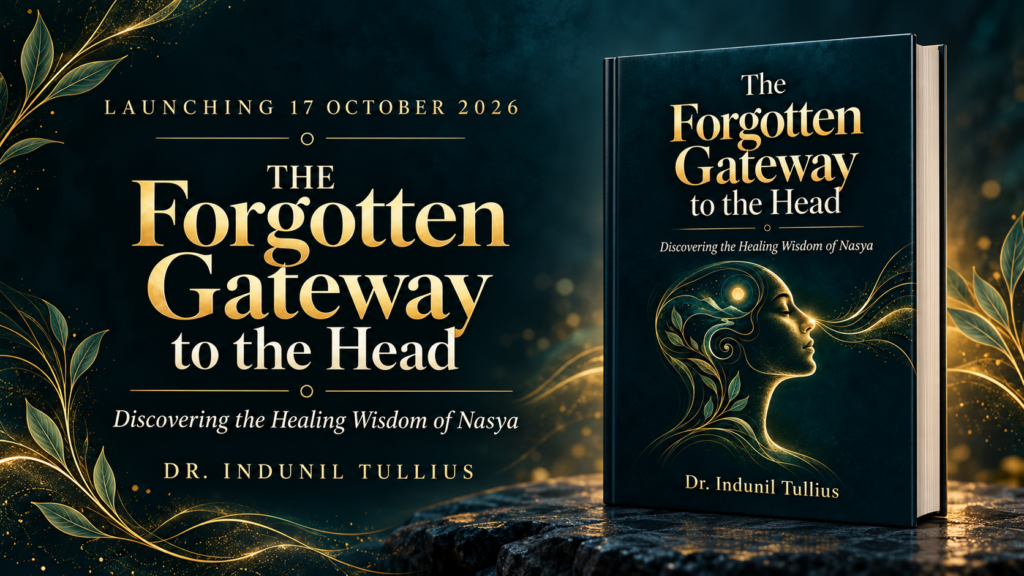
An ancient healing tradition. A forgotten gateway. A new perspective on the head.
What if the nose offered a pathway to understanding the head in a different way?
The Forgotten Gateway to the Head introduces readers to an age-old approach to caring for the head through the nose. Written for a general audience, it brings traditional healing wisdom into clear, accessible language and explores a practice that many readers may not have encountered before.
For anyone curious about traditional approaches to wellbeing and the often-overlooked connection between the nose and the head.
Eine alte Heiltradition. Ein vergessenes Tor. Ein neuer Blick auf den Kopf. (German Translation – The Forgotten Gateway to the Head)
Was, wenn die Nase einen besonderen Zugang zum Verständnis des Kopfes eröffnet?
Das vergessene Tor zum Kopf führt in eine überlieferte Heilkunde ein, die den Kopf durch die Nase betrachtet. Verständlich geschrieben, macht das Buch traditionelles Wissen zugänglich und lädt dazu ein, eine vielen Menschen noch unbekannte Praxis neu zu entdecken.
Für alle, die sich für traditionelle Wege des Wohlbefindens und die oft übersehene Verbindung zwischen Nase und Kopf interessieren.

Articles
Staying Healthy After Flooding and Storms
Arjuna – eine Heilpflanze mit kardiovaskulärer Relevanz
E-Books
Culinary Herbs & Spices (Compact Version) 15€
In this e-book, you will learn about the Ayurvedic properties like tastes, doshas etc. and the action of almost all culinary herbs and spices in a compact yet informative way. Useful for anyone who wants to quickly find information about Ayurvedic herbs and spices.
English Version:
German Version:
The Ayurvedic Perspective of Common Metabolic Disorders 15€
In this Ebook you will find information about metabolic disorders like diabetes, thyroid problems, rheumatoid arthritis etc. from Ayurvedic perspectives. This is a compact version in which you will find essential information as well as several Ayurvedic tips for the prevention of metabolic disorders.
English Version:
Recetas Saludables (Spanish version) 10€
una versión concisa de algunas recetas saludables para el desayuno, el almuerzo y la cena en español.
Farmacia de cocina – Nutrición saludable (Spainish) 35€
Este libro electrónico es una versión completa que enseña sobre la digestión, alimentos saludables como aceites, especias, etc., e incluye actividades prácticas.